
Basement Wall Crack Types: Horizontal vs Vertical vs Stair-Step
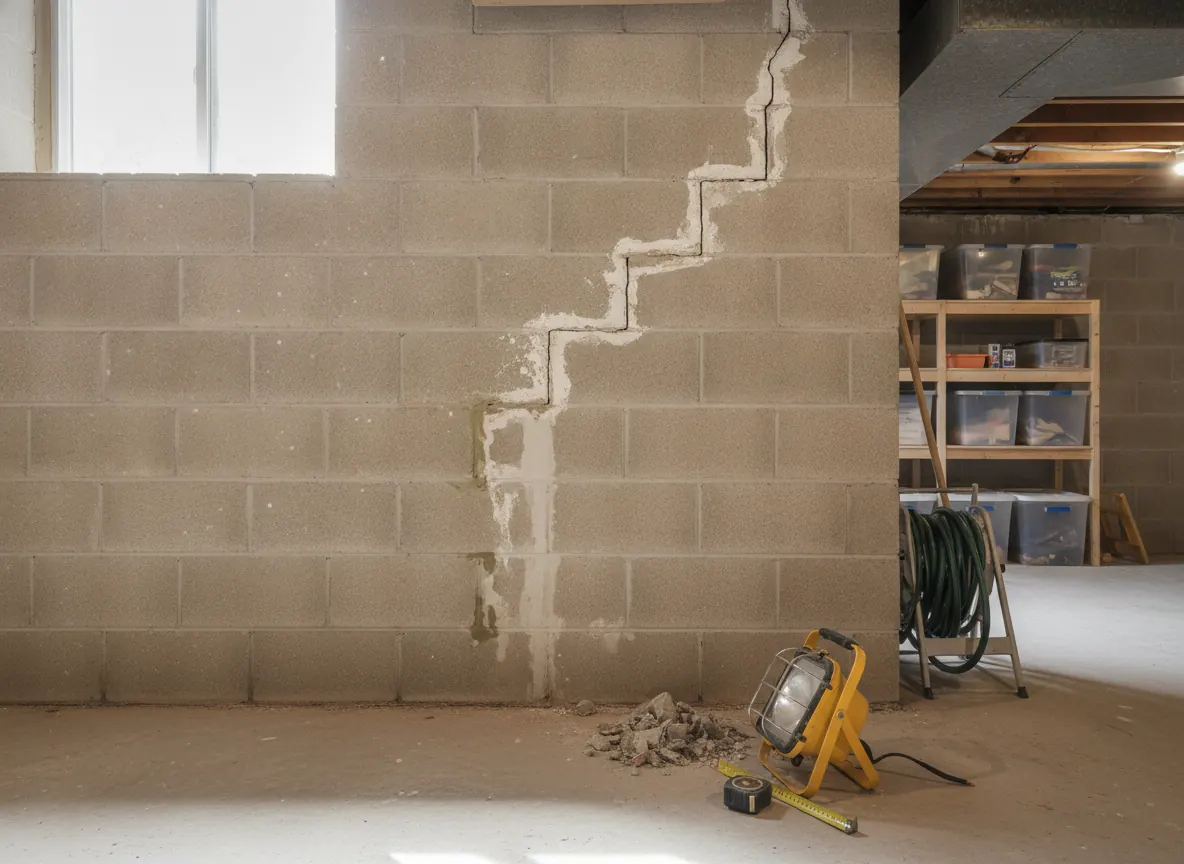
Most basements in northeast Kansas have a crack somewhere. The question is whether yours is a harmless shrinkage line or a sign that something is moving. The direction of the crack, the wall material, the width and whether it is changing tell you a lot. This guide walks through the common crack types homeowners in Topeka, KS find, what each one usually means, and when to bring in someone to measure it.
Start with the wall material
Basement walls around the region are mostly poured concrete or concrete block, with some older stone walls. Census figures (ACS 2020–2024) put Topeka's median year built at 1967, with 68% of homes built before 1980, so many houses here have older block or stone basement walls. Cracks behave differently in each.
- Poured concrete is one solid piece. Cracks tend to run vertically or diagonally through the concrete.
- Concrete block is many units with mortar joints. Cracks usually follow the joints, horizontally or in a stair-step pattern.
- Stone walls show movement as loose or shifted stones and crumbling mortar more than as clean cracks.
The main crack types compared
| Crack type | Where you see it | Common causes | How concerned to be |
|---|---|---|---|
| Vertical, hairline | Poured walls | Concrete shrinkage while curing | Often minor; watch for leaks or widening |
| Diagonal | Poured walls, often from a window or corner | Uneven settling, stress at openings | Monitor; assess if it widens or offsets |
| Stair-step | Block and brick, along mortar joints | Settling at one end, outside pressure | Assess if wider than a hairline or growing |
| Horizontal | Block walls, partway up; sometimes poured | Soil pressure pushing the wall inward | Get it assessed |
| Floor slab crack | Basement or garage floor | Shrinkage, settling of fill below | Usually minor unless one side drops |
Vertical cracks
A thin vertical crack in a poured wall is the most common crack homeowners find. Concrete shrinks as it cures, and that shrinkage often shows up as one or two vertical cracks. On their own they are usually not structural, but they can let water in. Injection with epoxy or polyurethane is a common fix for a leaking crack. A vertical crack is more concerning when it is wider at the top than the bottom, when one side sits out of line with the other, or when it keeps widening.
Stair-step cracks
In block and brick, stress follows the weakest path, which is the mortar. A crack that steps up or down along the joints often means one part of the wall has settled relative to another, or that the wall is under pressure from outside. Corners are common spots. A hairline stair-step crack that has not changed in years may be old news. One that is widening, that has shifted blocks or that shows up with sticking doors or sloping floors deserves a closer look, because settling may call for piers rather than a patch.
Horizontal cracks
A horizontal crack running along a block wall, often a few courses below the top or near mid-height, is the type to take most seriously. This Old House notes that horizontal cracks are more likely than vertical ones to signal structural issues. They usually mean soil on the outside is pushing the wall inward. About 46% of Shawnee County is mapped in clay soils with high or very high shrink-swell potential (USDA NRCS soil data), mainly Martin and Pawnee soils, and clay that swells when wet can add to that pressure. Check your own lot on Web Soil Survey.
Hold a straightedge or a taut string along the wall. If the middle sits in from the top and bottom, the wall is bowing. Our guide to wall anchors vs carbon fiber vs steel beams explains the usual fixes, and the bowing basement wall repair page covers the process.
Horizontal crack or bowing? Engineer first. Before paying for a large wall repair, consider an independent structural engineer's assessment. This Old House puts it at $300–$1,000. The engineer should not be tied to the company selling the repair, so the report describes the problem rather than a product. See foundation inspections.
How to monitor a crack
- Photograph the crack with a ruler or coin beside it, and date the photo.
- Pencil a short line at each end of the crack, with the date.
- Measure the widest point with a crack gauge or a set of feeler gauges.
- Check after heavy rain, after a dry spell and after a hard freeze.
- Note any damp spots, white mineral deposits or water at the base of the wall.
A crack that has not moved in a year is a different conversation from one that grew a sixteenth of an inch since spring. That record also helps any company or engineer who looks at it.
What crack repair costs
Fixr lists crack repair at $200–$1,000, and This Old House at $250–$800. Those figures cover sealing or injecting the crack. If the crack is a symptom of a bowing wall or settlement, the quote will include the wall bracing or piers too. See the foundation crack repair page and the foundation repair cost guide for the full set of ranges.
Typical national ranges from published 2024–2026 cost guides (Fixr, This Old House, Forbes Home), not quotes. Your price depends on an on-site inspection.
Before you sign
Kansas doesn't issue a state license for foundation contractors. Inside Topeka city limits, contractors must hold a City of Topeka contractor license and pull a building permit for structural work; Lawrence, KS has its own license and permit rules. Ask for the license, proof of liability insurance and the permit number. The city guide for Lawrence, KS notes that crack injection may be exempt from a permit, while structural repairs are not. Ask what the warranty covers, whether it transfers to a buyer, and get it in writing.
Common questions
Is a horizontal crack in a basement wall serious?
It is the crack type most worth an assessment. This Old House notes that horizontal cracks are more likely than vertical ones to signal structural issues, because they often come from soil pressure pushing the wall inward. Have an independent structural engineer or local company measure the wall for bowing.
Are vertical cracks in a poured basement wall normal?
Thin vertical cracks in poured concrete are common and often come from shrinkage as the concrete cured. They can still leak. Watch for cracks that widen, offset so one side sits out of line with the other, or are wider at the top than the bottom.
What does a stair-step crack mean?
A stair-step crack follows the mortar joints in a block or brick wall. It often points to settling at one end of the wall or to pressure from outside. A hairline stair-step crack may be minor; one that keeps widening or comes with bowing or sticking doors deserves a closer look.
How much does crack repair cost?
Fixr lists crack repair at $200–$1,000 and This Old House at $250–$800. Those are national ranges for the crack itself. If the crack comes from a bowing wall or settlement, the repair that addresses the cause usually costs more.
Get quotes from local companies
Topeka Foundation Experts is a free quote service, not a contractor. Describe what you are seeing once and independent foundation repair, basement wall and waterproofing companies serving Topeka, KS and northeast Kansas can reply with quotes. Companies may pay to receive requests, and there is no obligation to hire anyone. Request free quotes or call (785) 502-9116.